
Jaimie Tarleton was first inspired to pursue mental health as a career when she was a resident assistant in undergrad and saw first-hand the mental health struggles of college students and how they are often overlooked.
Samantha Shiver knew she wanted to start her own counseling practice, so she decided to chart an academic path that will earn her the appropriate license so she can help as many people as possible.
Brooke Parker learned through her undergraduate coursework in criminology that many interventions that can reduce crime are not implemented and said that addressing mental health care and its stigma came up repeatedly.
Tarleton, Shiver and Parker all arrived at the University of North Georgia’s (UNG) Master of Counseling program through their own journeys, but they were all driven by a passion for helping others through mental health. This is also how they ended up in the mental health graduate assistant program that serves the Athletic department and the Corps of Cadets at UNG.
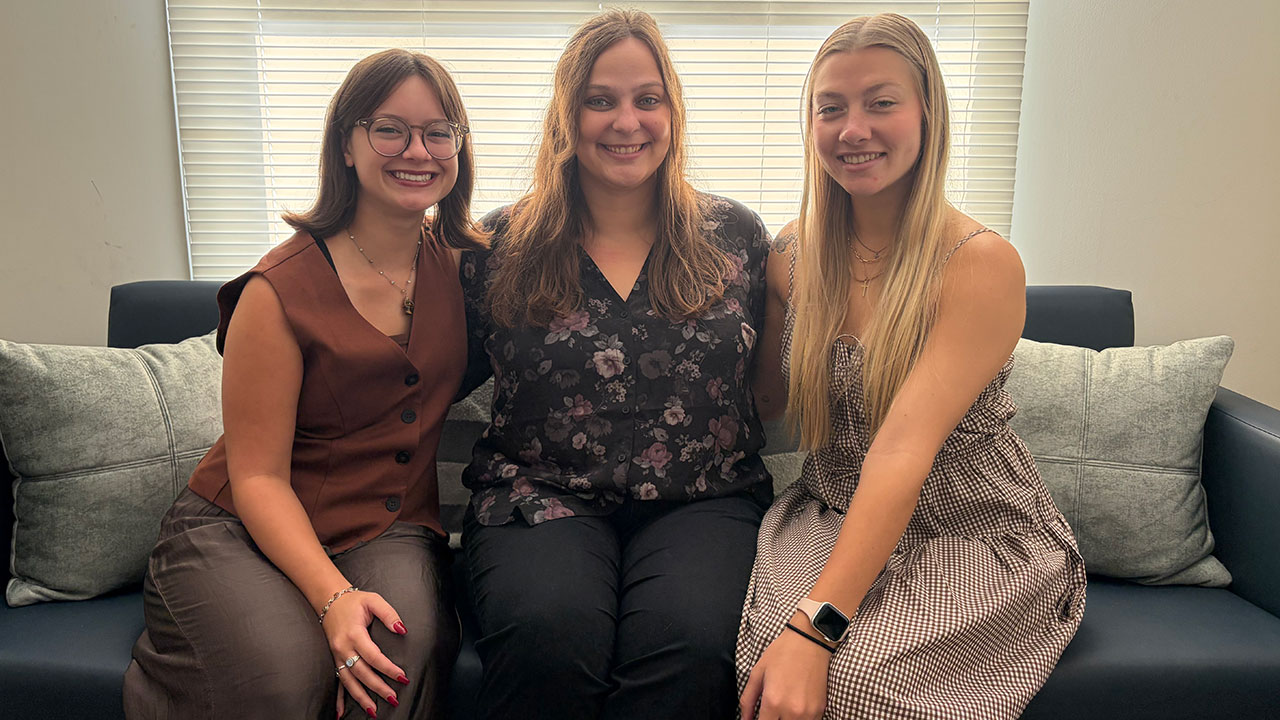
Left to right: Samantha Shiver, Brooke Parker and Jaimie Tarleton.
The program allows student-athletes and cadets to set up 30-minute mental health check-ins with mental health graduate assistants, which offers a lower-pressure opportunity for mental health help than a traditional counseling setting. Students seeking help can schedule an appointment on an app or pop in for a visit. If the student-athletes or cadets are facing a more serious situation, the mental health GA’s can refer them to professionals at the student counseling center to address their needs.
Drawing from her own life experience, Parker recognizes the profound impact of mental health support and is grateful for those who encouraged her to seek it.
“I received mental health care when I was younger, and the only thing different about me and a lot of people who don’t, is where I grew up and who my parents are. That’s nothing I could control,” Paker said. “There’s a lot of people in the world who don’t have access to mental health support. I wanted to go into mental health because I want to be somebody’s cheerleader, I want to be their support.
For Tarleton, the mental health GA position allows her to bring together her own experience as a college athlete with her passion for mental health.
“I played sports my entire life and I’ve always known that I wanted to work in athletics in some capacity, whether that was physical therapy or athletic training. When I saw the gap in mental health for athletes, I thought this might be my forte. I can do this,” Tarleton said. “Once I saw that this position [for the mental health graduate assistants] was available, I immediately told my advisor this is exactly what I want to do.”
All three agree that the mental health GA program has been impactful for them and for the students they work with.
Parker was one of the first students to serve in the mental health GA program. She said the mental health GA office is located in the athletics building, making it easy for athletes to pop in for one-on-one sessions. Parker said the first year was slow, but with support and buy-in from the coaches, administrators and athletic trainers, they have had four times as many students reach out this year.
Parker said that she appreciates being able to provide the tangible mental health skills she is learning in class to student athletes.
“The opportunity to practice skills and have hard conversations before going out into an internship or the workforce has given me so much experience and so much rich connection, and I feel so much more confident,” Parker said. “We’re all growing here. It benefits everybody involved, which I think is a really cool aspect of this program.”
Shiver similarly said that being a mental health GA gives her first-hand experience of working with clients.
“It’s an opportunity that not a lot of people get in this program, to be able to sit in front of a person over a long period of time, week by week, see their progress, and talk about goals,” Shiver said. “Getting to be in the collaborative therapeutic relationship is game-changing.”
Shiver, who is working with cadets, sees how this program can be a workaround when dealing with mental health stigma. She said that students who are commissioned by the Army have to report when they’re seeing mental health professionals, which may keep students from getting care at the student counseling services. She said that since she isn’t a mental health professional yet, they don’t have to report meeting with her.
“I act as a bridge so that they don’t have to make that scary step. If someone comes to me and they’re feeling overwhelmed with academic distress— let’s talk,” Shiver said.
Being a college athlete, Tarleton is able to quickly build a rapport with athletes because she understands challenges such as performance anxiety. Her shared experience often helps athletes feel more comfortable opening up, giving her an opportunity to develop and practice clinical skills.
“Learning to sit with someone, even through pain as they’re crying to you, that is a skill in itself because sadness and grief is hard,” Tarleton said. “It’s training that is unmatched.”
All three students agree that a master’s degree is a crucial path to the workforce.
“There’s no way I could do my career in general without a master’s degree. If I didn’t have a basic understanding of theoretical orientations, then there’s no way I would be able to operate from a cognitive behavioral therapy mindset, or a dialectical behavioral therapy mindset,” Tarleton said. “A master’s degree is essential.”
“I think graduate school has taught me the importance of networking. I am so grateful for the life experience that graduate school brings,” Shiver said. “There’s people here with PhDs, there’s people here who have three kids. There’s so many different walks of life, and you learn so much just from hearing other people’s life experiences.”
Parker, Shiver and Tarleton all stressed the importance of more access to mental health care for everyone. Parker said that improved mental health for individuals has a trickle-down effect for everyone around them.
“You can get through hard things and deal with stress. You can navigate conflict resolution,” Parker said of having skills in managing mental health. “You feel more confident in yourself, and these are all big life skills that people take with them through school, through jobs, through families.”
Parker said that ultimately, she wants people to know that it’s ok if you were never taught how to regulate your emotions and that it’s something people can learn at any time in their life.
“It’s a skill we aren’t taught in school and there’s no shame in needing to learn that. Because it is hard, especially if no one’s talking about it,” Parker said. “My goal is that I want people to talk about it.”